PRP, PRF GFC – Can I get a vowel
PRP or GFC After a Hair Transplant? Don’t Get Rinsed.
Don’t get rinsed by expensive clinic upsells.
So you’ve had a hair transplant. Congrats — the hard part’s over.
Now every clinic under the sun is trying to flog you PRP or GFC injections “to boost your results.”
Let’s be clear:
You don’t need them.
And anyone telling you otherwise is more interested in your wallet than your hairline.
What Is PRP or GFC?
- PRP (Platelet-Rich Plasma): They spin your blood in a machine and inject it back into your scalp.
- GFC (Growth Factor Concentrate): Basically PRP with a fancy brand name and a bigger price tag.
Both are marketed to speed up healing and stimulate growth — but here’s the truth.
What They Won’t Tell You
- PRP or GFC won’t improve graft survival: Your grafts are either in or they’re not. Injecting platelet goo doesn’t change surgical skill.
- They won’t magically boost growth: Most post-transplant growth happens on its own between months 3–9. PRP doesn’t fast-forward that.
- Zero long-term benefit backed by solid data: Studies are small, biased, or inconclusive. “Better results” often means “thicker existing hair for four weeks.”
- It’s a cash cow: Clinics love selling PRP packages because it’s low effort, high margin. No regulation, no guarantees.
What to Do Instead
Here’s what actually protects your result:
- Finasteride or Dutasteride – blocks DHT, protects native hairs
- Topical Minoxidil (with or without Tretinoin) – improves thickness
- Microneedling (0.5 mm–1.0 mm) – boosts absorption
- Ketoconazole shampoo – keeps the scalp clean and healthy
Spend £300 a year on clinically proven treatments, not £300 a session on blood-spin sales pitches.
Beyond the Basics: Sapphire Blades & Laser Hats
1. Sapphire Blade “Upgrade”
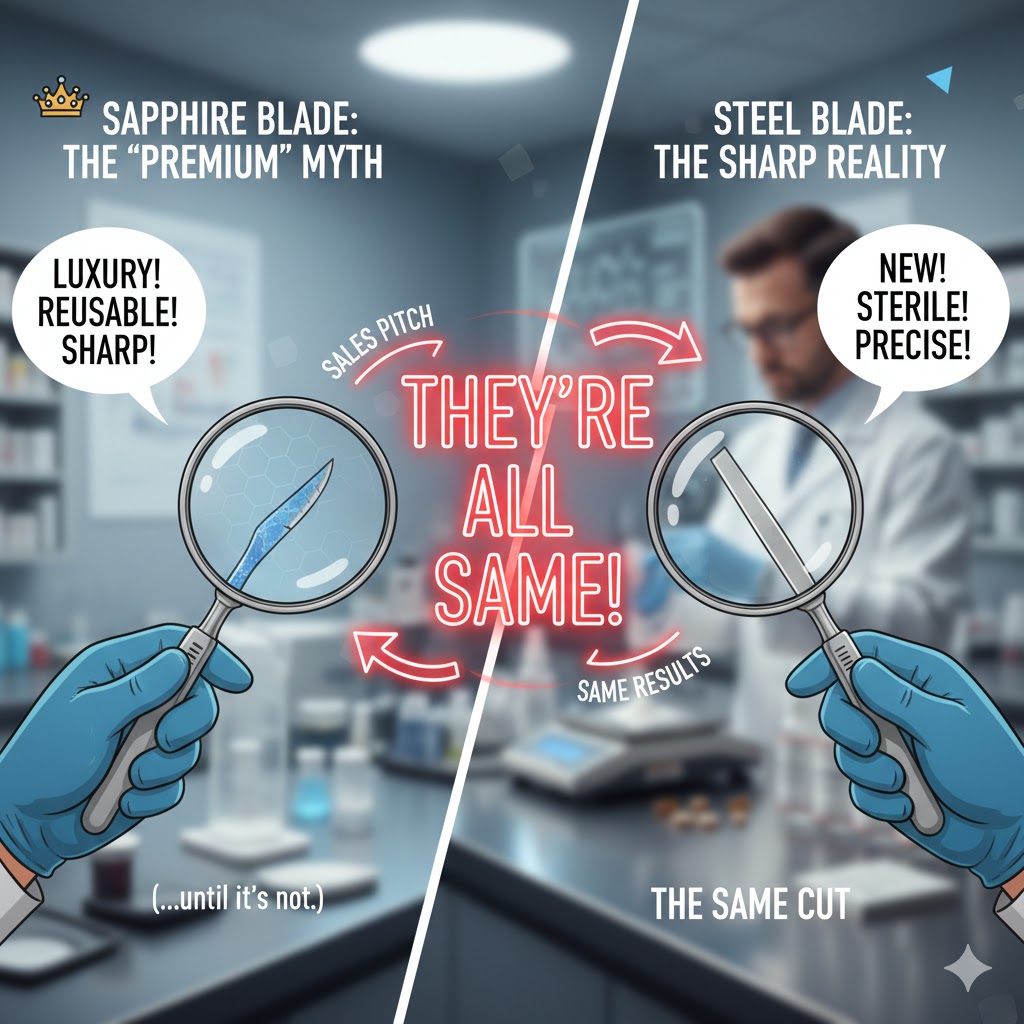
“THEY’RE ALL THE SAME!” — Don’t pay for the crystal, pay for the skill.
Some clinics charge extra for a “sapphire” FUE, implying it’s thinner, sharper, or somehow superior to traditional steel blades. In reality, sapphire vs. steel is mostly marketing. Key facts:
- Sapphire blades are reusable. They’re not magically sharper forever—after a handful of recipient-site “punches,” they start to dull just like any other reusable tool.
- Steel blades can be single-use. Many practices use disposable steel punches that guarantee a fresh, ultra-sharp edge for every patient. A brand-new steel punch is just as fine as a sapphire blade, with zero risk of wear.
- Blade thickness is essentially the same. A brand-new sapphire punch and a freshly manufactured steel punch are within a fraction of a millimeter of each other.
Bottom line: If your surgeon offers a fresh, single-use steel punch option, that is every bit as safe and precise as a reusable sapphire blade. The real advantage comes from surgeon skill, not the blade material.
2. Low-Level Laser Therapy (LLLT) Hats & Caps
Another “must-have” upsell you’ll see: a home-use laser cap or helmet. Here’s the reality:
- LLLT after transplant: There’s no high-quality, large-scale trial proving that a laser cap worn right after transplant will boost graft take.
- Risk of false hope: If you shell out £300–£800 for a “laser hat,” you may be doing so at the expense of truly evidence-based steps like early topical minoxidil.
Bottom line: A laser hat isn’t harmful, but consider it a low-priority, optional extra at best. It’s more “nice-to-have” marketing than a must-have post-transplant.
Putting It All in Perspective
For the vast majority of transplant patients, spending on the right surgeon + strict aftercare (minoxidil, vitamin support, gentle wash) is far more impactful than dropping extra on “sapphire” tools or laser hats. If budget is tight, funnel that money into clinically proven treatments—not the latest upsell fad.